
See Qualio in action.
Explore pricing for your team or book a 30-minute demo with our team.
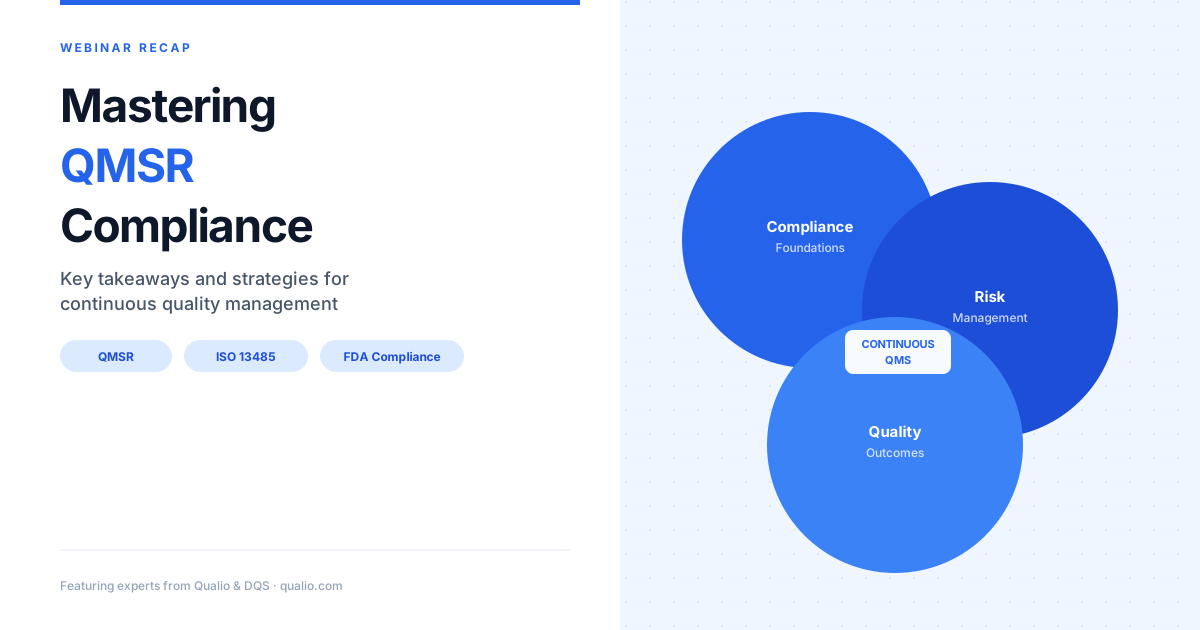
Webinar Recap: Mastering QMSR Compliance and Moving Toward Continuous Quality Management
Last week we hosted a webinar by Tina Karimi, Senior Product Marketing Manager at Qualio, a panel of experts came together to share insights on Quality Management System Regulation (QMSR) compliance, the industry shift toward continuous quality management, and how businesses can proactively adapt to new regulatory frameworks.
Featuring insights from Yuan Li, Director of Medical Business for North American Operations at DQS; Sumatha Kondabolu, Senior Quality Business Partner at Qualio; and Sarah Raux, Staff Product Manager at Qualio, this session offered attendees actionable guidance for navigating regulatory changes while maximizing operational efficiency.
Whether you're responsible for compliance strategy, quality systems, or operational audits, this blog covers the webinar's key takeaways to help you align with QMSR requirements and elevate your quality management processes.
Key Themes and Takeaways
1. The Role of QMSR and Its Alignment with ISO 13485:2016
Yuan Li provided a comprehensive overview of the FDA's transition from QSR (21 CFR 820) to QMSR, emphasizing its harmonization with ISO 13485:2016. The new regulation integrates ISO standards while adding FDA-specific requirements like Unique Device Identification (UDI), post-market surveillance, and stricter traceability mandates.
What Changed:
- Enhancements in sections covering production controls, records, and UDI requirements
- Stricter expectations for documentation traceability
What Remained the Same:
- FDA's legal authority remains uncompromised, with continued focus on post-market activities such as medical device reporting and complaint handling
- Risk-based inspections will persist, ensuring a nuanced evaluation methodology even as traditional QSR audits are phased out
Li highlighted the strategic advantage of this harmonization:
"You don't need to do that anymore with this referencing and QMSR. You essentially just need one QMS… that means you will have less duplication in your documentation and processes, reducing internal audit costs and streamlining regulatory inspections."
Further alignment with ISO standards also creates easier market access to countries like Canada, the EU, and Japan, while enhancing credibility with FDA and certification bodies.
2. Shifting Quality Management Mindsets: From Compliance to Outcome
Sumatha Kondabolu advocated for a fundamental mindset shift within quality management systems, framing compliance as a starting point rather than an end goal:
"Compliance is just step one. What matters is whether your quality system works in practice, consistently delivering safe, effective products and supporting smart decision-making."
She outlined three pivotal areas for transformation under QMSR:
Proactive Supplier Management
Traditionally, quality teams evaluate suppliers after procurement decisions, operating reactively. Under QMSR, they should co-own risk management earlier in the selection pipeline. Practical steps include:
- Diagnose current processes by mapping supplier qualification timelines and identifying gaps where quality could intervene earlier
- Move upstream by defining risk-based criteria and performance thresholds before suppliers are selected
- Build evidence by documenting justification for outsourcing decisions and connecting supplier performance to ongoing compliance reviews
Embedding Quality in Product Design
Quality's role often starts at gatekeeping stages such as final approvals — but QMSR pushes quality upstream, embedding it at the beginning of product design. Kondabolu advocated for co-defining risk criteria alongside engineering teams during initial design phases, creating traceability that links early-stage decisions with final outcomes.
Strengthening Complaint Handling
Effective complaint handling defines whether a QMS delivers results in practice. Kondabolu stressed the need for quality functions to lead complaint evaluations and align with other support teams to track MDR (Medical Device Reporting) statuses proactively. Under QMSR, complaint handling crosses functional silos, builds continuous feedback loops, and systematizes decision traceability.
3. Operational Cadence: Continuous Risk Management
Both Li and Kondabolu discussed the operational cadence needed to meet QMSR's continuous improvement requirements — transitioning from episodic audits and inspections to dynamic, real-time systems that monitor process health consistently.
"Shifting quality upstream also means evolving operational cadence… instead of episodic involvement, there is an 'always-on' approach that ensures continuous risk awareness." — Sumatha Kondabolu
4. Qualio's Compliance Intelligence Platform
In the second half of the webinar, Sarah Raux demonstrated Qualio's Compliance Intelligence platform, showcasing how automation and dynamic frameworks can ease the transition to QMSR processes.
Prebuilt Compliance Frameworks
The platform offers out-of-the-box frameworks for FDA, ISO, EMA, and other key compliance standards — prebuilt and premapped controls, ready to implement.
Real-Time Gap Analysis
The system continuously scans your QMS and flags gaps against regulatory requirements, ensuring ongoing compliance rather than point-in-time audits. As Raux explained:
"Every time a document is updated, it flows through and gets reassessed in real time."
This keeps teams proactive and avoids the firefighting often associated with lagging indicators.
Integrated Task Assignment and Gap Remediation
Compliance gaps can be assigned to team members with clear remediation instructions and tracked within the platform to closure. Updates automatically trigger reassessment workflows, reducing manual effort.
The platform has delivered measurable real-world results — improving audit preparation timelines by 80% for companies like SendTech — by aligning operational documentation within one cohesive platform.
5. Best Practices for QMSR Implementation
During the Q&A, Kondabolu and Li explored specific strategies for shifting toward a proactive, structured quality management approach.
Start Small, Then Scale
Kondabolu advised against overhauling everything at once. Instead, start with one decision point or process area to introduce quality earlier, ensuring cross-functional teams receive transparency into risk criteria and regulatory expectations upfront.
Look Beyond Lagging Indicators
While CAPAs and audit results are important, they only address past events. For proactive compliance, cycle time metrics — such as time from issue detection to closure — offer better insights into how systems perform operationally.
Don't Assume ISO 13485 Equals FDA Compliance
Li warned against solely relying on ISO 13485:2016 certification:
"Having third-party certification under ISO 13485 doesn't automatically mean FDA compliance."
Companies must still account for FDA-specific requirements such as post-market surveillance and labeling.
Key Quotes
- Sumatha Kondabolu: "Compliance is not about checking a box — it's about co-owning outcomes and aligning your quality function with the product lifecycle and performance expectations."
- Yuan Li: "The FDA's post-market surveillance and UDI requirements are unique. Pay detailed attention to those as you move toward QMSR alignment."
- Sarah Raux: "Our platform reduces duplicative effort while continuously monitoring compliance gaps so your team can focus on innovation and long-term risk mitigation."
Moving beyond traditional compliance models to risk-based frameworks requires robust systems, clear strategies, and modernized software. If your team is ready to align with QMSR requirements or wants to reduce the overhead of compliance management, consider reaching out toQualio or DQS at sales.us@dqs.de for expert guidance.
Stay proactive, strategic, and focused on outcomes as you modernize your quality function for global regulatory success.
Meg Sinclair
Meg has amassed over a decade of experience as a QA/RA and compliance professional, with a range of cross-functional skills and knowledge spanning from non-profits to medical device start-ups. <br> <br> Meg is Senior Quality Specialist at Qualio, a member of the expert quality success team, and a certified auditor for both ISO 9001 and ISO 13485.
LinkedInSee Qualio in action.
Explore pricing for your team or book a 30-minute demo with our team.